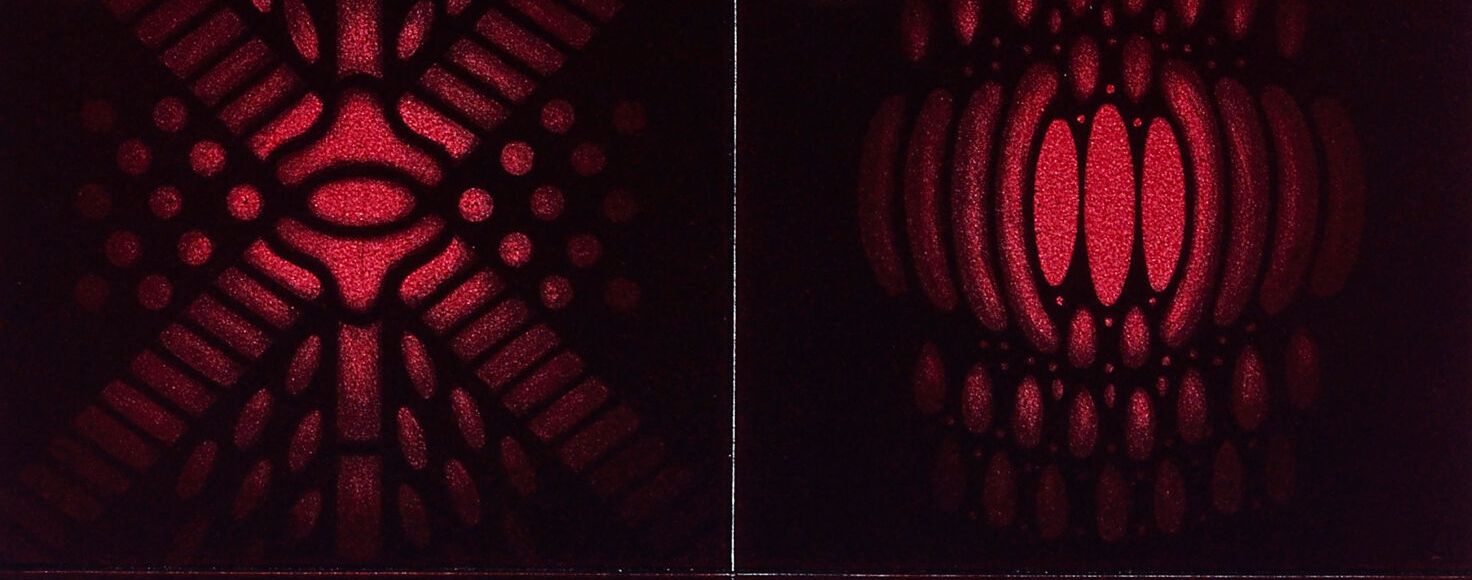
A candle on the table and the Sun in the window are both hot things glowing, each made of countless atoms flashing on their own schedules. Two narrow slits ask any light a simple question: can you interfere with yourself? The answer depends on something you would not think to check.
Chapter 3 · Source
In Step
A candle, two slits and the Sun. What lets light interfere with itself? Find out, then use the answer to measure a star.
Look first
Light added to light, making dark
Cut two narrow slits half a millimetre apart in a piece of foil. Look through them, or let their light fall on a wall, while a small lamp shines from far across a dark room through a green filter.
The light from the two slits overlaps, and the overlap is striped. Bright bands, where crests from one slit meet crests from the other. Dark bands between them, where crests meet troughs. In the dark bands, two lots of light add up to almost none.
Two slits are the tidiest form of an experiment Thomas Young reported to the Royal Society, published in 1804, as proof that fringes come from the interference of two portions of light. Look at the stripes for a moment, and at how dark the dark ones are.
The light on the wall, a few fringes either side of the centre. One fringe is λ/s = 1.1 milliradians wide: about a millimetre on a wall a metre away.
Commit to a prediction
Use a candle instead
Same slits, same green filter. Now the light comes from an ordinary candle on a table one metre away. Its flame is about a centimetre wide.
What appears on the wall?
Candle at 1 m · fringe contrast 0.01: none to see.
Now carry the same candle to the far end of a long corridor, twenty metres away. Nothing about the flame changes. It is the same wax, the same flicker, the same light.
Same candle at 20 m · fringe contrast 0.69: plainly there.
The fringes come back. So whatever stopped them at one metre was not the kind of light a candle makes. It was something about where the candle was.
Why the first guesses made sense
Every point makes fringes
If you chose A, you were right about something important. Light from any single point of the flame, passing through the two slits, makes perfect fringes. Every point does. The trouble is that there are many points, and they are in different places.
A point at the left edge of the flame reaches the right-hand slit by a slightly shorter path than the left-hand one. That shifts its whole fringe pattern a little to one side. A point at the right edge shifts its pattern the other way. Points in a flame have nothing to do with one another; each flickers on its own. So their patterns do not interfere with each other. They simply add, as brightness.
If the shifts are small, the patterns line up and the sum is still striped. If the shifts spread across a whole fringe, every bright band of one pattern is filled in by dark bands of others, and the sum is flat.
If you chose C, you were right that the flame’s points are independent. That is what “incoherent” really means here. What was wrong was thinking it settles the matter. How far the patterns shift depends on the angle the flame fills, seen from the slits. Carry it away and the angle shrinks.
At 1 m: patterns from points across the flame (faint) spread over more than a fringe; their sum (bold) is flat.
At 20 m: the same points shift their patterns by less than half a fringe; the sum keeps its stripes.
Here is the rule that follows. A source that fills an angle α shifts the patterns from its edges by sα/λ fringes, where s is the distance between the slits. The fringes survive while that is well under one. Turn it around: light from the source keeps step across a width of about λ/α. This width is called the coherence width. Slits closer together than that see light in step; slits farther apart see light that simply adds.
The bench
Two slits and any source
Choose the angle your source fills, how far apart the slits are, and the colour of the light. The wall is drawn so that one fringe always has the same width; in reality the fringes get finer as the slits move apart. The faint curves are the patterns from single points of the source; the bold curve is what you see.
The wall
Fringe contrast against slit separation, for this source
Reading the curve
The contrast falls to zero at the coherence width, then comes back weakly. Those small revivals are real, and Michelson used the first zero.
Things to try
- Start from the candle at one metre. How small must the flame’s angle get before the fringes are clear? How far away is that for a centimetre-wide flame?
- Keep the source fixed and slide the slits together. Where do the fringes come back?
- Switch to white light at a source angle where the fringes are clear. Count how many fringes you can see either side of the centre. Then try the 10 nm filter.
What you can now say
Light from a source keeps step across a width of about its wavelength divided by the angle the source fills. Two points closer than that receive light that can interfere. Farther apart, their light simply adds as brightness.
So coherence across a beam, the kind that decides these fringes, is not a kind of light. It is a relation between a source, a distance and a pair of points. Any source becomes coherent across a pair of points if you take it far enough away, or make it small enough.
There is a second, separate limit, and this one does belong to the light itself: its colour. A filter that passes a range of wavelengths Δλ lets you see only about λ/Δλ fringes either side of the centre, because each colour’s fringes have a slightly different spacing and drift out of step. White light gives two or three; a green filter about a dozen. A laser’s spectrum is so narrow that its fringes run on almost without end, which is the real sense in which laser light is special.
For the determined reader: the rule, worked cases, and its limits
The quantities
| Symbol | Meaning | Unit |
|---|---|---|
| s | distance between the two slits (or mirrors, or points of a specimen) | m |
| α | angle the source fills, seen from the slits (full width for a strip, full diameter for a disc) | rad |
| λ, Δλ | central wavelength, and the width of the spectrum | m |
| V | fringe contrast, (Imax − Imin)/(Imax + Imin) | none |
The rule
A point of the source at angle β shifts its fringes by sβ/λ periods. Averaging cos(2πsβ/λ) over a uniformly bright source gives the contrast:
strip of width α: V = | sinc(sα/λ) |, first zero at s = λ/α
disc of diameter α: V = | 2J1(x)/x |, x = παs/λ, first zero at s = 1.22λ/α
This is the simplest case of the van Cittert–Zernike theorem: the coherence across two points is set by the Fourier transform of the source’s brightness. A bright source edge-on gives a sinc; a disc gives the same function as the Airy pattern of a round lens.
Worked cases
| Source | α | Coherence width | V at s = 0.5 mm |
|---|---|---|---|
| Candle, 1 cm, at 1 m (strip) | 10 mrad | 55 µm | 0.010 |
| Same candle at 20 m | 0.5 mrad | 1.1 mm | 0.69 |
| The Sun (disc) | 9.3 mrad (0.53°) | 72 µm | 0.007 |
| Betelgeuse (disc) | 0.047″ | 3.0 m | 1.000 |
What changes if one quantity changes. Double the distance to a source and its angle halves, so the coherence width doubles. Halve the wavelength and the width halves too. Widening the spectrum does not change the coherence width at all; it limits how many fringes you can see either side of the centre, about (2 ln2/π)(λ/Δλ) before the contrast halves, for a smooth spectrum: six for a 40 nm filter at 550 nm.
Where the rule stops
It assumes a source of even brightness; real stars are darker at their edges, which Michelson and Pease noted would change their answer slightly. It assumes small angles, narrow slits, and a source whose points are entirely independent, which is true of flames, lamps, the Sun and fluorescent dyes, and not of lasers. It says nothing about flicker: the contrast is an average over the time you look, and a flame’s flicker changes its brightness, not the geometry.
A case you have not seen
Point the slits at the Sun
The same slits, half a millimetre apart, and the same green filter. Now the light comes from the Sun, low in the sky, through a window. The Sun is a hundred and fifty million kilometres away.
What appears on the wall?
The Sun, slits 0.5 mm apart · fringe contrast 0.007.
Distance was never the point. Angle was. The Sun is enormous and very far away, and the two almost cancel: it fills half a degree of sky, about the same angle as a candle flame at arm’s length. So its light keeps step across only 72 micrometres, a seventh of the gap between these slits.
If you chose A, you carried over “farther away makes fringes”. That was true of the candle because moving it shrank its angle. The rule asks for the angle, not the distance.
Young knew
When Thomas Young described his first fringes to the Royal Society, published in 1804, he did not simply let sunlight through a window. He made a small hole in the window shutter, covered it with a piece of thick paper, and pierced the paper with a fine needle. Only then did he hold a slip of card, about a thirtieth of an inch wide, in the cone of light, and see fringes inside its shadow, formed by light passing either side of the card.
The needle hole was the trick. Seen from his table, a hole a fraction of a millimetre across fills an angle tens of times smaller than the Sun. It made sunlight coherent across the width of his card.
Turn it around
Measure a star
If the angle sets the separation at which fringes vanish, then the separation at which they vanish tells you the angle. Point two widely spaced mirrors at a star, combine their light, and move them apart until the fringes disappear.
Betelgeuse, the red star at the shoulder of Orion, fills an angle about forty thousand times smaller than the Sun. Sunlight keeps step across 72 micrometres.
At what mirror separation should Betelgeuse’s fringes vanish?
Forty thousand times smaller in angle means forty thousand times wider in step: 72 micrometres becomes about three metres.
The measurement
The idea is Hippolyte Fizeau’s, from 1868. In 1873 Édouard Stephan tried it at Marseille, with two openings in front of an 80 cm telescope mirror. He looked at every bright star he could. Even at his widest spacing, 65 cm, no star’s fringes weakened at all. That null result was still a measurement: every star had to be smaller than about 0.16 of an arcsecond.
In 1890 Albert Michelson used the method to measure the moons of Jupiter. For stars he needed a much wider spacing, so with Francis Pease he mounted a twenty-foot steel beam with four mirrors on the 100-inch telescope at Mount Wilson. On 13 December 1920, in very good seeing, they could find no fringes from Betelgeuse with the outer mirrors 121 inches apart, although other stars showed the instrument was in perfect adjustment. Assuming an evenly bright disc, that gives 0.047 of an arcsecond.
It was the first time the size of a star other than the Sun had been measured. With its distance, Betelgeuse came out hundreds of times wider than the Sun.
Back to the microscope
The condenser is the Sun of the specimen
Now the question from the end of chapter 2 has an answer. Seen from the specimen, the source is the opening of the condenser. Close it to a pinpoint and it fills almost no angle: the light is in step across the whole field, every stria with every other. That is Abbe’s case, where side beams and a sharp cutoff decide everything.
Open it, and the specimen sees a wide disc of light. With the condenser opened to a numerical aperture of 0.65, light on the specimen keeps step across only about half a micrometre: about one stria spacing. Neighbouring striae are then lit almost independently, like the points of a glowing shell, and the image moves toward Helmholtz’s case of gently fading detail.
So the dial in chapter 2 was a coherence dial all along. The condenser diaphragm sets how far light on the specimen stays in step. Try it on the chapter 2 bench: open the condenser and watch spacings below the old cutoff come back, faintly.
Where this explanation stops
In step, and still no fringes
Everything in this chapter treated light as a wave with one property that mattered: its timing. Two beams in step make fringes; out of step, they add as brightness.
In 1819 François Arago and Augustin Fresnel took light from a single point, split it into two beams that were perfectly in step, and changed one thing. They arranged the two beams to be polarised at right angles to each other: Fresnel by passing them through two halves of a sawn calcite crystal set crosswise, Arago by putting stacks of thin glass plates in front of two slits. However carefully they matched the paths, the two beams never made fringes.
The light was in step, from one point, through two slits. What else must two beams share before they can interfere, and what does that say about what is waving?
End of chapter 3
Added to your notebook
Light from a source keeps step across about its wavelength divided by the angle the source fills. Closer than that, light interferes; farther apart, it adds as brightness.
What must two beams share, besides their timing?
Chapter 4 · The Black Cross