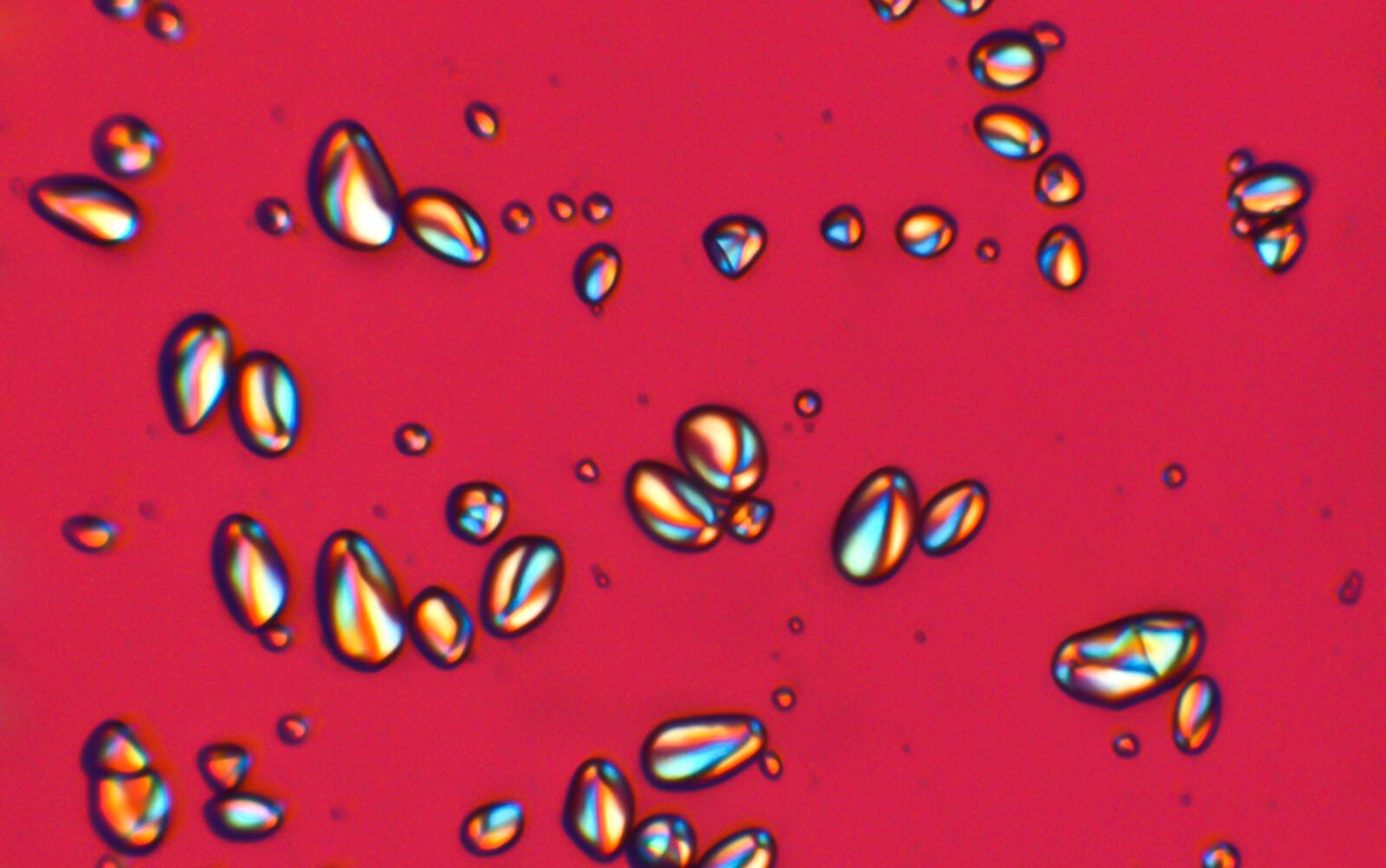
Starch is the most ordinary substance in the kitchen, and under a microscope it is nearly invisible. Put it between two crossed filters and every grain lights up out of the dark, each one marked with a black cross.
Chapter 4 · Specimen
The Black Cross
A grain of potato starch between two polarising filters. Turn it, watch the cross, then learn to predict its colours.
Look first
A grain that only shows itself in the dark
Scrape a cut potato and put a drop of the cloudy juice on a slide. It is full of starch grains, each a few tens of micrometres long. In ordinary light they are nearly invisible: clear lumps with faint outlines.
Now put one polarising filter below the specimen and another above it, turned at right angles to the first. With no specimen the field goes black; the two filters together pass nothing. But each starch grain lights up, and across each one lies a black cross. Its arms meet at a point near one end of the grain, the hilum, where the grain began to grow.
Take a moment with the cross. Its arms are straight, and they meet at the hilum even though the hilum is off-centre.
Ordinary light. The grain is almost clear glass.
Between crossed polarisers. The black cross meets at the hilum.
Commit to a prediction
Turn the grain
Leave both filters where they are. Rotate the microscope stage, and the slide with it, by 45 degrees.
What does the black cross do?
Stage at 0°.
Stage at 45°. The grain turned; the cross did not.
The oval turned. The cross kept its arms east–west and north–south, the directions of the two filters, and simply moved with the hilum. So whatever the cross is, it belongs as much to the filters as to the grain.
Why the first guess made sense
There is structure. The cross is where it lines up.
If you chose A, you were right that the cross tells you about structure inside the grain. Starch is built from long chain molecules laid down in layers, and within the grain they run outward from the hilum, like the spokes of a wheel. The cross is the evidence for that.
But the cross is not the spokes. It is the set of places where the spokes happen to point along one filter or the other. Those places are always east–west and north–south of the hilum, however you turn the grain, because a spoke pointing east still points east after the grain has turned: it is simply a different spoke.
To see why those places are dark, and everywhere else bright, we need to say what a polarising filter does.
The mechanism, in ordinary language
Light’s vibration happens across its direction of travel, and it has a direction of its own: up and down, side to side, or anything between. A polarising filter passes only the part of the vibration along one direction. Light that comes through vibrating east–west is stopped completely by a filter that passes only north–south. Hence the black field.
Many crystals, and starch, have two special directions across the light’s path, and light vibrating along one travels a little slower than light vibrating along the other. This is called birefringence. Light that arrives vibrating along either special direction passes through unchanged, and the second filter still stops it. Dark.
Light that arrives vibrating at an angle is split into two parts, one along each special direction. One part falls behind the other on the way through. When they come out and recombine, the vibration is no longer purely east–west, and part of it passes the second filter. Bright.
In the grain, the special directions are along the spokes and across them. Where a spoke points east–west or north–south, the light passes through unchanged and is stopped. That is the cross.
The bench
Filters, a crystal plate, and a grain
On the left, a plate of birefringent crystal between the two filters, lit by daylight. Its colour is computed from the light it lets through at every wavelength. On the right, the grain. Turn things and watch.
A crystal plate
Interference colours, plate at 45°, crossed filters
The grain
Things to try
- Turn the plate’s slow direction to 0° and to 90°. What happens to the colour, at any retardance?
- Turn the analyser from 90° to 0° with no plate effect (slow direction at 0°). That is Malus’s law: the light passed falls as the cosine squared of the angle between the filters.
- With the plate at 45°, slide the retardance from 0 upward. Grey, white, yellow, orange, a deep magenta at 550 nm, then blue. Remember the order: it is the key to the case you have not seen.
- Make the grain thicker. Its quadrants run through the same colours.
What you can now say
Light vibrates across its path, in a direction. A birefringent material has a slow and a fast direction; light vibrating along either passes unchanged, and light at an angle comes out changed. Crossed filters show where those directions lie at an angle to them, and where they do not.
The colours come from the delay. White light contains every wavelength. The same delay is half a wavelength for one colour and a whole wavelength for another, so some colours pass the second filter and others are stopped. What is left looks coloured, and the colour tells you the delay, once you know which order it belongs to: the same yellow appears near 330 nm and again near 900.
For the determined reader: Jones calculus, a worked case, and its limits
The quantities
| Symbol | Meaning | Unit |
|---|---|---|
| θ | angle of the plate’s slow direction from the polariser | degrees |
| Γ | retardance: how far the slow part falls behind, as a distance (thickness × difference in refractive index) | nm |
| λ | wavelength | nm |
| φ | angle between the two filters | degrees |
The calculation
Describe the light’s vibration by two complex numbers, its east–west and north–south parts. A plate with slow direction θ delays the slow part by a phase δ = 2πΓ/λ:
J = R(θ) · diag(1, e−iδ) · R(−θ)
where R is a rotation. Multiply the incoming vibration by J for each plate in turn, then keep the part along the analyser and square it. Two closed forms follow:
no plate: I = cos²φ (Malus’s law)
crossed filters, one plate: I = sin²(2θ) · sin²(πΓ/λ)
The first factor is zero when the plate’s directions lie along the filters: the arms of the cross. The second depends on colour: the source of the interference colours.
A worked case
A plate with Γ = 275 nm, in green light of 550 nm, between crossed filters. At θ = 45°: sin²(90°) × sin²(90°) = 1, all the light passes. At θ = 22.5°: sin²(45°) × 1 = 0.5. At θ = 0°: 0. With Γ = 550 nm at 45°: sin²(180°) = 0, the green is stopped completely; red and violet partly pass, which is why a 550 nm plate looks magenta in daylight.
Two plates. Plates whose slow directions are parallel act as one plate with the retardances added. Crossed, they act as one plate with the difference. A red plate is a 550 nm plate made for this purpose.
How the colours are computed
For each of 31 wavelengths from 400 to 700 nm, the transmission is weighted by a 5500 K daylight spectrum and by the CIE 1931 colour-matching functions (the analytic fit of Wyman, Sloan and Shirley, 2013), summed into a colour, and converted to screen colour. Printed charts look softer because ink cannot reach the purest of these colours.
Where the model stops
Light is assumed to cross the plate straight on, with ideal filters, and the birefringence to be the same at every wavelength. The starch grain is a model: an ellipsoid whose slow direction points outward from the hilum and whose retardance is proportional to its thickness, peaking at 120 nm, within the grey-to-white range real starch shows. Real grains are layered and imperfect, and their crosses are less tidy.
The dispute
Light that remembers a direction
In 1690 Christiaan Huygens, who had explained the double image seen through a crystal of Iceland spar with his wave theory, added a puzzle at the end of his chapter on it. Pass a ray through one crystal and it splits in two. Pass those two rays through a second crystal, and what happens depends on how the second crystal is turned. In some positions each ray goes through without splitting again. Turned a quarter-turn, they still do not split, but they swap which kind of refraction they undergo. In every other position each splits again, into four images of varying brightness.
Huygens concluded that light leaving the first crystal must carry some form or disposition that the second crystal could read, and admitted he had found nothing to explain it. For his waves, which he pictured like sound, pushing and pulling along the direction of travel, there was no such thing. A push along the path has no sideways direction to remember.
The answer came more than a century later. Arago and Fresnel showed in 1819 that two beams polarised at right angles never interfere, however well their paths are matched. Fresnel took the bold step: light’s vibration must be across its path, not along it. A vibration across the path has a direction, and the second crystal reads it. The cost was strange. Only a solid can carry vibrations across a wave’s direction, so the medium of light would have to behave like an elastic solid, filling all of space. The evidence that forced the idea on Fresnel was that refusal to interfere.
The strangeness was resolved, not by finding the solid, but by giving it up. In the 1860s James Clerk Maxwell’s theory of electricity and magnetism showed that light is an electric and magnetic field travelling through space, and such a field vibrates across its direction of travel by its nature. What vibrates is the electric field. Its direction is what a polarising filter selects, and what the second crystal in Huygens’s puzzle was reading.
A case you have not seen
Slide in a red plate
Back to the grain, crossed filters, daylight. Now slide a 550 nm plate, a red plate, into the light path. Its slow direction runs diagonally, from lower left to upper right.
The black background turns a deep magenta: the plate on its own, at 550 nm. Remember that the grain’s slow direction points outward from the hilum, along the spokes, and that its own retardance is about 100 nm.
What colours do the four quadrants of the grain turn?
Red plate in, slow direction ↗.
In the upper-right and lower-left quadrants, the spokes run from lower left to upper right: along the plate’s slow direction. The two delays add, 550 + 100 = 650 nm, and the colour moves up the chart from magenta to blue. In the other two quadrants the spokes run across the plate’s slow direction, the delays subtract, 550 − 100 = 450 nm, and the colour moves down to yellow-orange. Along the arms of the cross the grain changes nothing, and they show the plate’s own magenta.
Notice that remembering the cross did not help. The quadrants depend on something the cross cannot show: which way the slow direction runs.
One more turn. Some structures have their slow direction running around the centre, like the rings of a tree, instead of outward. Same red plate, same orientation. Which quadrants turn blue?
Slow direction running around the centre.
The colours swap. That is how microscopists tell the two kinds of structure apart: the black cross looks the same for both, the red plate does not. Starch is reported to show blue upper right and lower left; some structures in wood show the reverse.
Which way a red plate’s slow direction runs varies between makers; Evident describes northwest–southeast as usual for its plates. Check the mark on your own plate before reading the colours.
Where this explanation stops
A quarter of one
Everything here treated light as a smooth vibration that a filter can trim. Turn the analyser to 60° from the polariser, and Malus’s law says a quarter of the light gets through: cos²60° = 0.25. Trimming a vibration to a quarter of its strength is easy to picture.
Now dim the lamp, far down, until a sensitive detector behind the filters records light one click at a time. Each click is a whole, indivisible event. There is no such thing as a quarter of a click.
Malus’s law still holds, on average. What does the filter do to each single one?
End of chapter 4
Added to your notebook
Light vibrates across its path, in a direction. Crossed filters show where a material’s slow and fast directions lie at an angle to them; a red plate shows which is which.
What does a filter do to a single click of light?
Chapter 5 · One at a Time